Showing posts with label Training. Show all posts

Thursday, April 7, 2016

Pooches: Mr. B's Stuffy Confusion

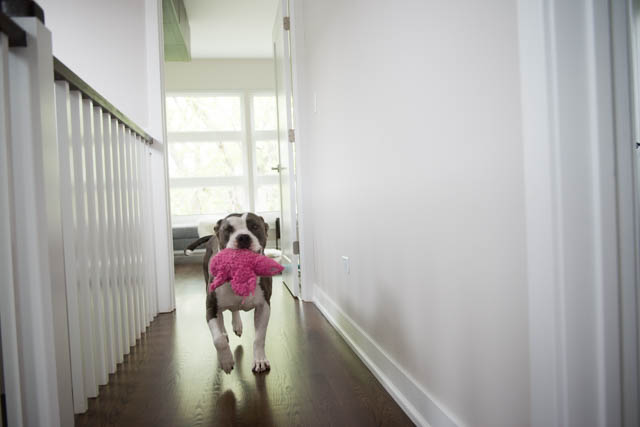
People usually know Mr. B as the one that loves his stuffies so much.
Even "Creepy Baboon".
While we try to keep his collection neatly stored away, he is always unpacking them to surround himself with his best friends in his lair by the fireplace.
Now with Baby K, (who Miss M still thinks is our new foster dog), our biggest concern was figuring out how to teach Mr. B the difference between his stuffies and Baby K's stuffies.
Pre-baby, we met with Rendy from Anything is Pawnable to learn a strategy.
Since dogs can't reason, the biggest difference is by scent. When Baby K gets new toys, we can mark them with a dab of Listerine so the pups can start to recognize there is a difference.
It's also a good idea to get stuffed toys that are different than Mr. B's typical stuffies.
Though we would like to say that the giant dinosaur and the giant polar bear were for Baby K, I admit that I have been eyeing these giant stuffed animals for awhile, especially the giant dinosaur.
We never had a reason to have these in our house, until now. They were actually our first few purchases for Baby K's arrival, even before the crib, bassinet, clothes and diapers.
Though we didn't expect Mr. B to do this when we unboxed them.
Which also happened with the dinosaur.
Also:
Check our Facebook page for more photos, comments, and story lines beyond the blog.

Wednesday, January 14, 2015

City Dog: On Attempting to Maintain Dog Training in the Winter

Since there can be so many unexpected things we encounter on our city walks (Three-legged rats! Gyros in snowbanks! Drunk people trying to put sombreros on our pups!) we like to treat all of our walks like training walks so our pups are ready for the unexpected.
Over the years the pups have become accustomed to the routine. Practicing waves. Knowing to sit at every corner. And always checking in with us for directions.
Though as we've been spending our winter climbing snowbanks and navigating icy sidewalks, training has become an after-thought.
At the same time, we always regret the lapse once we remember how hard spring walking can be.
Here are some ways we're trying to keep up our training:

Focus on the Main Focus
During the warmer weather, when we can actually walk on the sidewalks, we have quite the repertoire of tricks.
They wave.
They wait.
They lay down at the raise of a hand.
Miss M even walks around me in a circle.
We do these to keep the pups' communication and focus. Which is nearly impossible to do when navigating snowdrifts.
So we just work on check-in's. This is our most important training to keep the pups' attention on us, which we can even do among the snowdrifts. We wrote more about it, here. 

Making our Treats Accessible
With the distractions of the snowbanks and narrowing sidewalks, we often need treats to keep the pups' checking in. And there has always been a conflict between keeping hands warm and dispensing treats.
I like using treats that can be broken into smaller bits for treating. Ours are long jerky-type sticks where I can just hold one stick and break it into smaller pieces for treating.
I also like walking with flip-top gloves which can make it easier to hold things.

Gearing Up
The biggest thing is making our pups comfortable in the colder weather so they do have the chance to focus. If it's too cold, Mr. B will try to sprint away (that is until he reaches the end of the leash).
We've learned the art of layering, which we talk more about in this post.
We use dog boots when sidewalks are icy and covered with salt, but we also make sure to practice wearing walking with the boots inside so they will be comfortable once they get outside. We wrote more about it, here. 

Anyone else have tips on keeping up your training when the weather gets rough?

Also:
How to exercise your pups when you can't go outside.
And with shorter walks.
Forgetting winter.
Check our Facebook page for more photos, comments, and storylines beyond the blog.

Wednesday, October 1, 2014

City Dog: Using Our "Secret" Recall Word

While we knew there would be a transition period for the pups when we moved, we hadn't thought about how we would need to have new training and routines just because of the space itself. 
The biggest thing we're realizing right now is how living in a single-family home our front door leads directly outdoors so the pups have more potential to plan an escape:
In our old place, our front door led to the stairs in the hallway which was closed in by the main building door. So even if they left our unit's front door, they would just be trapped in the hallway.
So we got a bit lax, and we let the pups step out in the hall to welcome people into our home.
Which now means they think they can still leave our front door and step directly outdoors to welcome people into our home.
We do have a front gate, but we've noticed that sometimes when people come to visit they haven't closed the front gate completely or they are still coming in leaving it open enough for an escape. 
We also know much Mr. B loves to run:
During one of our training classes long ago, we learned how to create a secret emergency recall word. The idea is once the pups hear this word they will forgot whatever urge they have to run off and they will turn back, robot-like, and return to us.
We use a word that is "special" that we would not use in normal conversation around the dog, but is also something we could easily yell out in an emergency.
We chose the word "Yikes!".
It takes a couple of months to embed the word. We start out by yelling "Yikes" followed by "Come" and when the dogs come running they are greeted by the best food ever. And we make sure to praise them heavily.
Eventually we are able to eliminate the "come" and just use the "yikes" with further distances within our home. And we always need to make sure to have the best food.
We've been consistently reinforcing it, and we've also heard it's important to only practice when we know they will come to make sure it really would work in an emergency.

The pups are really enjoying the extra treats that come with this type of training.
Has anyone else been working with potential escape artists?

Also:
Bringing back the stay space.
We did develop this gate system so the pups are always in sight whether we let them out front or back.
Check our Facebook page for more photos, comments, and story lines beyond the blog.

Thursday, June 26, 2014

City Dog: The Dog Trick We Never Expected to Use Most Often

When Miss M first came to live with me, I always joke that she was 'raised by wolves'. She had no focus, always needed to be entertained, and she just couldn't sit still. It was really taking her to a basic training course that changed both of our lives and I realized how much Miss M loved to learn.
We have written a lot about how we use basic dog commands in our every day lives, but unexpectedly, it became one of Miss M's vanity tricks, the "wave" command, that has become her most frequented trick:

Keeping Focus:
With every walk we go on, probability is high that we will encounter oncoming excited pups, chicken bones, drunken people trying to grab the pups (and often all of the above!). With these being the expected, plus the even crazier unexpected, we know how important it is to maintain constant routine and communication treating all of our walks like a training walk. The pups do a great job with "check-in's" and throughout our walk we will ask the pups for sits and stays, and throw in the "wave" command for variation.

Being Approachable:
Even though we feel lucky to be a part of a community where there are so many fellow pit bull-type dogs, we know there are many people who are still wary. Having our pups focusing on us, and doing cute 'parlor tricks', does make them more approachable and we often have many people coming up to meet them. My favorite is when we do hear an offhand comment to have the pups sit right at our side, then wave. Usually the other people waiting at the corner with us will say something positive to outweigh any of the negatives.

The Humor in It:
With all of the photos we take of the pups, we love the option of 'wave' because it does give us some funny variations.
We also love when children walk by and wave at the dogs and we can have Miss M wave right back (though she's usually looking at me when she does it).

How we Taught the Wave Command:
We taught the wave command as a variation of 'shake'. We started by holding our hand out as if we were going to do the shake but then put our hand slightly out of reach so they had to try pawing at us to reach our hand. We marked the pawing in the air motion (we say "yes, wave!") and eventually we were able to change the hand signal instead of reaching out to meet their paw to just waving.
We think it's a little harder for Mr. B with his stubby T-Rex arms.

Are there other pups out there showing off their 'wave' commands? Or do you have other 'vanity tricks' that you are using on a more than regular basis?

Also:
Remember when we tried to teach it to Mr. B and this happened?
This one changed our lives
Circus Dog!
Check our Facebook page for more photos, comments, and story lines beyond the blog

Tuesday, April 8, 2014

Pooches: Making a "Stay Space" with Verbal Command

While we've learned to live in a smaller space with our bigger pups, we've also learned this means they become involved in everything.
Which isn't always good.
Like when they really want to meet that delivery driver who is terrified of dogs. Or when they want to come investigate the glass that shattered across the floor. Or when I'm trying to mop that one area they keep walking across. Or even when something unexpected like this happened.
So, we created a "stay space" in our home where we can send the pups if they need to quickly get out of our way. Our "Go to Bed"command elicits a type of robot-like response where the pups will retreat even if there is something more interesting going on.
This is how it worked for us:

Creating the Best Place Ever:
We have mentioned before that Miss M only lives for two things: breakfast and dinner. The mere mention of these words will bring on the crazy-eyes.
Knowing how food motivated our dogs are, we made their beds the 'best places ever' by only feeding them in their beds. They also only get their kings and treats if they go to their beds. When the pups see us getting treats out, they often automatically go to their beds.
Once there, they always practice waiting and they need to "stay" before they get their treat.

Linking the Verbal Command:
Since we already had the pups going and staying, as they were running to their beds we would add the verbal command "Go to Bed" and reinforce "Yes, go to bed" once they got there.
Miss M picks up verbal cues quickly, and I think Mr. B learned just by watching Miss M.
We even had our fosters learn the command by watching our pups. You can see our pooches moving with lightning speed, and former foster dog Wilma learning, in this video at the bottom here.

Reinforcing with Random Surprises:
Since the pups get their meals in their beds we are able to reinforce the command daily. Sometimes we even leave hidden treats and toys in their beds to reinforce that the bed really is a fun place where they want to be.

Also:
The essentials.
Making the dog-area 
Tepee.

Thursday, January 30, 2014

Pooches: How to Make Dog Baths Easier

My fear of dog-bathing began when Miss M and I were bachelorettes together.
It was just me and my 70 pound dog. 
We became a living comic-strip; a small girl trying to wrestle her 70 pound dog into the bath tub. 
And much like any comic-strip, there were many tub-escapes, falls, and slippery dog-chasing.
Fast-forward a few years, I felt ready to tackle home dog baths again. But this time with more of a plan than just tossing Miss M in the tub. Luckily, our baths are no longer comic-strip worthy, and we even figured out how to bathe both pups at the same time.
This is what worked for us:

Training your Dog to Love the Bathtub
Given Miss M's earlier Coyote-and-Roadrunner antics, and the fact she hated even going near the bathroom, I wanted to teach her to love the bathtub. We would practice sitting together in the tub without water, and I would make it fun by giving her the best treats she ever tasted. To get her to enjoy exploring the bathtub by herself, I would randomly leave these amazing treats in the tub for her to find. This helped increase her positive associations with the tub as a good place.
Once she felt more comfortable with the tub, and she was actually in the tub with water, I would continuously give her these amazing treats as she was bathing.
After the bath, the pups are rewarded by getting a different"the best treats ever". Through these associations, the pups willingly take baths.

Using the Right Tools: 
We always loved the self-serve dog wash places because they make things so easy, so we tried to set something up similarly in our own home. We bought a removable hand-held shower hose that makes it easy to hose down all those hard-to-reach areas, and rinse them off quickly. The hose also makes it really easy to rinse the hair off of the tub, and we use a hair-catcher on the drain so it doesn't get clogged. We keep all of our cleaning supplies in one place (those dorm caddies still come in handy!) which is easy to pull out. A vet tech told us putting cotton in their ears will prevent water from getting in and potentially getting an ear infection. We also keep wipes to clean inside their ears. We still need to get some non-slip things for the inside of the tub as Mr. B tends to slide around with his stubby little legs.

Save Time
Once our pups learned to love the bathtub, and we had our tools together, we learned a couple of ways to save time. Our treat association with the bathtub taught the pups to jump right in by themselves; we don't have to worry about picking up our big dogs. Since they now enjoy the baths, we save time by bathing them together. We also make it a team effort where E and I work together as an assembly line to wet-lather-rinse and dry. Though sometimes E does most of it so I can get photos.

We tend to bathe our pups about once a month because we have learned this about Chicago Grime and Miss M starts to smell like Fritos. If they are extra-dirty between baths, we wipe them down with a waterless shampoo spray.
These are things that work for us, what are some other bath tips you use for your pups?

Also:
Being preventative
We didn't know there were other benefits to this
This is what people are always asking us about
Check our Facebook page for more photos, comments, and storylines beyond the blog.

Tuesday, January 28, 2014

Pooches: Teaching our Pups a "No Word" without using the Word "No"

While we're always working with our pups to be responsible pooches in the city, we also know that everything is constantly a work-in-progress.
Our pups usually understand the structure we have set, but much like a sulky tween our Miss M can be quite demanding. Usually she is vocally complaining that the car is not being driven to her liking, or that she must be fed at this exact moment (anyone remember this infamous video?).
Sometimes there will be someone she really wants to meet on a walk, and if we don't let her meet them she will become frustrated making her "hungry-gremlin noise" and start playing tug-of-war with her leash. And we know she always wins.
After talking to our trainer, we realized we needed a word or signal to remind her that the behavior is unacceptable. We know all dogs and training philosophies are different, but this is what worked for us:

Finding a Word that Isn't "No"
It can be so easy to just yell "no" or "stop it" when dogs are doing things that we don't like. Not only do dogs not really understand word meaning , but a word like "no" is so easy to use that it really does lose all meaning. I found myself telling the dogs no for everything from licking my toes to not eating gyros off the sidewalk.
Our trainer recommended using a specific word, that we wouldn't normally say, to let the pups recognize its importance. The word we use is "Enough".  And it is said like we mean it.

Giving the Word Meaning
Miss M found that being vocal and playing with the leash worked because it gave her the attention she wanted. We needed to show her that these behaviors were not rewarding in this way. When she began complaining in the house we had to mark the bad behavior by yelling the word "Enough". Then we gave the word meaning by removing her from the fun situation, where she thought she was in charge, and isolating her to a not-fun situation. For us, we associated the word with putting her in a dark bathroom, with the door shut,  for 10 long seconds. Miss M quickly associated the word "Enough" as something not fun. She learned the complaining behaviors brought on the word "Enough".

Using it Sparingly
We know if we over-use the word it will lose its meaning so we only use the word for the most important situations.

This has worked well for Miss M, though it hasn't worked as well for Mr. B because he isn't as demanding and it's harder to catch him doing undesirable behaviors inside.

Also:
The dog-rules we never go back on
Don't forget this
Daily!
Check our Facebook page for more photos, comments, and story lines beyond the blog.

Tuesday, December 17, 2013

Pooches: On Party-Training

We always think it's funny that some people who read our blog believe that our dogs can do no wrong.
This is definitely far from the truth.
Much like the Von Trapp family, the pooches and I live by A's strict set of rules in our home. We have to be really strict about enforcing the rules so they are well-behaved in our home.
But I tend to break the outdoor furniture rule.
Knowing how food-motivated our pups are, we have a lot of rules about food.
The pups must perform a trick to get any type of treat.
They are not allowed to eat people food from the table.
To prevent scrounging, we also don't allow them to eat any of their dog treats if we happen to drop them and they fall on the sidewalk during our walks.
We thought that these were good rules, then we realized this makes them even more excited when someone breaks these rules for them.
It first started when we brought the pooches to one of my Family Parties.
Miss M's crazy-eyes emerge at the mere glimpse of food
My family thought the pups were so cute, they spent the entire night feeding them Korean BBQ, turkey, apples and Asian Pear from the table. Miss M realized all she had to do was look at someone and they would feed her. She didn't even need to perform a trick.
We think this ranks as their best night ever.
Though it all came to a close when Miss M decided to forgo the looking at someone and she just decided to feed herself.
By sticking her head in an entire bowl of potato salad.
Unfortunately, the pups are now conditioned to think that all parties are similar free-for-alls. And if people are not cooperating with Miss M's demands, she will become very vocal.
Remember that smashing-entrance we described when the pups' attended their black-tie party?
And it has become nearly impossible for them to be well-mannered at our Family Parties anymore.
So Miss M is not invited. And Mr. B is not invited by association.
We wonder if all of our rules and training as been a disservice in this type of situation.
There are a few dogs in our extended family who have all have been allowed to eat table scraps and they seem to do just fine at family parties.
On the other hand Miss M cannot contain her excitement, which eventually excites Mr. B.
How do you balance enforcing the rules when other people don't? And how to you re-condition once the rules have been broken?

Also:
How they do at home.
Pitbulls in Party Hats!


Check our Facebook page for more photos, comments, and story lines beyond the blog.

Tuesday, December 10, 2013

Pooches: Our Dog Training Essentials for a Polite Dog

While I always had dogs growing up, Miss M was the first dog I ever had on my own. I was a bit nervous to have my own dog, especially after being led towards a misguided Wiki-article predicting 
all types of dire traits. While these types of blanket statements are never true, it did scare me into becoming over-prepared and developing a solid training plan once Miss M came into my apartment. 
Vintage Miss M came to me as an excited, stubborn pup who knew what she wanted...and she wanted it now. While she will always have an over-the-top personality, we were able to develop some routines to help her make better decisions and become a polite dog.
We know all dogs are different, but these are some things that worked for us:

Start out Hard Because There's No Going Back
A friend of mine used to joke that I treated Miss M like she was in boot camp. Sure she had a lot of rules, but I also knew it was easier to set up a lot of rules up front because it would be harder to go back and have her un-learn a behavior. One of my biggest things was not letting Miss M on the sofa. I knew I could one day choose to allow her on the furniture in the future, but if I started out by letting her sit on the furniture I could never change my mind since it would be that much harder to train her to stay off.

We were also very strict about following the 'Nothing in Life is Free' principle. Miss M learned to work for every privilege. She wasn't allowed to just eat dinner, but she had to go to her bed, lay and wait as the food was placed before her. She wasn't allowed to eat until I gave her the command. She also learned to be in a down-stay before putting the collar on for walks, and she would never just get a treat but she would have to perform some kind of trick for it. (When she was newer it would start with just a sit, but it would work up to a wave, and eventually this!)
I can see how this looks intense to an on-looker, but Miss M could get very excited and these rules helped her learn patience, self-discipline, and understanding our routine. Now it has become automatic where sit has become the pups' default behavior.

Be Consistent
While Miss M was learning all of these routines, the biggest thing I needed to do was to be consistent. Sure, it was tempting to save time by just giving her dinner, throwing a leash on her if I was in a hurry, and giving her a treat just because she looked cute, but having a familiar routine is extremely important for dogs and not following the pattern could cause set-backs. 
We also make sure to consistently practice their training in new situations.

Using "Wait Time"
This is one of the biggest things I learned from teaching that I'm able to use on the pups. The idea behind wait time in the classroom is that after you ask a question you need to stop and wait to allow students to process what is being asked. Sometimes it seems like an uncomfortable amount of time and it's so tempting to just ask the question again, or rephrase it. Though I've learned if I do wait, even if it seems like a long time, I will always have a student answer or at least ask for clarification.
I started doing this with the pups when I give them commands. If they aren't responding immediately, it can be so tempting to repeat the command which will actually teach the pups not to listen to me the first time. So if I wait, it may seem like a long time but they will process, make a decision, and learn what I'm asking from them.
Notice how this video would have turned out differently if Mr. B was allowed wait time.

Having Role-Models
When we adopted Mr. B he was already 5 years old. We joke that he just came to us this way, but when we first met the big guy he was devouring baseball mitts in a single sitting and barking at anything that moved. We know dogs learn from each other and if they see a dog being rewarded for a behavior they may learn to do that behavior also. Seeing how Miss M would go to her bed when it was time for dinner and how she would wait nicely before walks, Mr. B learned these same behaviors. It has also worked with some of our foster dogs. Here is our very first foster dog, Wilma, during one of her first weeks with us. I never taught her this directly--and I don't think she would even stay on her own--but she would follow the behavior of both of our pups. (The pups are so close because none of the dogs are resource guarders).
What are some other things you consider essential in your training?

Also:
The command that changed our lives
Crowd Pleasers!
Living with a Circus Dog


Check our Facebook page for more photos, comments, and story lines beyond the blog.

Tuesday, October 15, 2013

City Dog: Focusing with Check-in's

We have found that the best part of being out and about in the city is that we get to use the skills we've learned in our training classes in real life. One skill that our pups have been over-using lately is the check-in.
The idea is that our pups remember to voluntarily check back with us, giving eye-contact, to communicate and get directions from us.
During our class, we would bring high-value treats and as we walked each time they would check back with us we would treat them. At first it was like an ATM machine, where they would immediately get fed a treat each time they made eye contact. Then we would stretch the time out between treating so it wasn't immediate. As the behavior became more automatic, we were able to increase the amount of check-ins before getting treated and eventually work on eliminating treats overall. We still bring treats on our walks as a reminder because our pups are so treat-motivated and we work on our other training.
This is why it has become one of our most used skills:

Keeping Pace
With so many interesting things going on, it can be so easy for our pups to get ahead of us or to fall behind. Check-in's remind them that we are working as a team and we all need to walk at the same pace. This is especially important when we are walking both of our dogs at the same time.
Our friends also wrote about using check-in's to walk two dogs, here. 


Avoiding Triggers (and Chicken Bones!)
We have been using this eye contact as a way to keep their attention as we navigate around some of the obstacles on our daily walks. If we spot skateboards, an overly-excited dog, a grumpy cat behind a fence, or the ubiquitous chicken bone, we can capture their attention long enough to navigate around the obstacle. Just the other day we had a young, large dog lunging at them trying to play but our pups didn't even notice because they were too busy focusing.

Navigating the City
In the city, so many things can happen at a moment's notice...like that time we were caught in a zombie flash mob. With check ins we know pups have learned to check back with us for guidance and direction if things get uncomfortable. Mr. B especially gets nervous when he hears dogs barking in cars like they're trapped. While he used to get excited and spring in the air on all fours, now he will look back at us for direction.
The funny thing is our pups take it very literally, and oftentimes they will spend an city block without breaking eye contact for the chance to get a sliver of a treat. Especially Miss M who has fallen off of curbs and walked into parked bicycles as she lets me know she is watching me so intently. She has become quite the source of comedy for people we pass. While it's hard to explain unless you see it, here is a video (with accompanying music!) showing Miss M's crazy eyes and bowlegged stance as she walks trying to keep eye-contact. Plus, a cameo by a bouncing Mr. B who is a bit more jovial:
Has anyone else been using this on their walks?

Also:
The training command that changed our life.
Who knew we would use this simple skill so much?
Parlor Tricks!

Check our Facebook page for more photos, comments, and storylines beyond the blog.

Tuesday, August 20, 2013

CityDog: The Two-on-One Walking Date

Perhaps I've been watching too many episodes of the Bachelorette, but after we wrote about how dog-walking is like dating we realized how much our own walks are like the 2-on-1 date. On the show it is the dreaded episode where the two suitors are pitted against one another on a single date to win the Bachelorette's attention. The stakes are raised because they know that she only has one rose and the other contestant is heading home in the mini-van.
This is exactly like our morning walks where I'm walking our two pups at the same time. They each have separate needs and I need to figure out how to give them both attention for different reasons. Though I have plenty of treats and no one is going home in the mini-van.
It has become a bit of a delicate balance as we spend the time working on each of their different needs.
The funny thing is that each pup is a 'savant' in the area that the other pup is working on.
On our walks, we are working on getting Miss M to pee and poo on command. She has a problem where she has to over deliberate, and she can often spend an entire walk without peeing. Each time she pees or poos, we mark the behavior with a treat so she learns to do it more often. And each time Mr. B pees or poos, we will also mark that so Miss M can learn from his example. The only problem is that Mr. B is an expert pee-er lifting his leg for every weed, corner, branch, piece of trash, or blade of grass that we pass.
At the same time, Mr. B is working on focus. He is afraid of small dogs, tall dogs, dogs barking behind windows and the feral cat colony on our street, and he tries to bolt with the speed of Scooby-doo cartoon legs whenever we encounter them. We have been focusing on getting him to do check-in's so when we do see any of his phobias, he won't notice because he is too busy focusing on us. Every time he makes eye contact and checks back with us, he gets a treat. The only problem is there is a certain someone else who has an over-attention problem and every 'look at me' intended for Mr. B involves the ever-widened eyes of a certain someone who does not need to work on focus and takes it all a bit too literally. 
It involves a lot of balance and the hope that they are actually improving in their deficit and not over-improving in their savant skill.
How do other people manage the needs of walking multiple pups at the same time?

Also:
Learning to walk two dogs at the same time.
Dog Speed dating
Did you know a certain 2 familiar pups are going to be Mr. and Miss July in the Unexpected Pitbull calendar? All proceeds go to rescue and you can get 15% with pre-order (and see our calendar page!) here.
Stay tuned tomorrow where we will announce the winner of our Ruffwear Swamp Cooler Vest Giveaway.

Tuesday, July 9, 2013

City Dog: How Dog-Walking is like Dating

Without a backyard, I used to lament needing to take our pooches on our daily walks. Eventually, I realized how this was important for us to have dedicated time spent together; I use this time to continue working on our training and communication.
And I think it's really because of these dedicated walks, my understanding of them and their understanding of me, that our pups are able to comfortably do things like this, this, and this.
I know it's hard to constantly be "on" with training, though one rule of thumb I use: if you wouldn't do it on a date, you probably shouldn't do it while walking on your dog.

If You're not talking and interacting, it's a boring date
You would never go on a date where you don't talk, bother to look at each other, or spend the entire time walking 3 feet behind your date. During our walks I make sure the pups are walking at my side and paying attention to me. We make it engaging by practicing tricks, using the city as an obstacle course, and working on check-ins that help them with distractions.

Give your full attention; walking and texting is rude
Much like you wouldn't answer a phone call or start texting in the middle of a date, it's also rude to do this when you're out walking your pup. I make sure the time I'm with them is their time, and this has helped me learn so much more about them helping with our communication and lessoning frustrations. I know certain areas where Mr. B will bolt because he expects to see a feral cat, I watch for growing mushrooms so Miss M won't try to eat one, and I've learned our pooches' bathroom habits that are really helpful to know when I need them to go quickly.

Don't Let your Date Check out Other Dates
Much like you would be upset if your date spent time head swiveling and trying to interact with other dates, we let our pups know this walking time isn't a time to go out and meet other dogs. This is our time to walk, and if our pups are able to meet a dog then they will expect to meet every dog we meet. Which is challenging when there are probably 30 dogs living on our block alone. We also know when dogs stare it can be considered uncomfortable and challenging to other dogs, so we keep our pups focused on us as a courtesy to all the other dogs out with their people.
These are some things we've observed.

Are there any other ways you think dog walking is like dating?

Also:
Check out our Facebook page for extra photos and storylines that don't always make the blog
How we really use it
This was the dog command that changed our lives
Our dogs like showing off like this
Related Posts Plugin for WordPress, Blogger...